In the fast-paced world of quick-service restaurants (QSR), winning the lunch rush can make or break your daily revenue. With hungry customers making split-second decisions about where to eat, geofencing has emerged as one of the most powerful tools in a media buyer’s arsenal.
By drawing virtual boundaries around specific geographic locations, QSR brands can deliver hyper-targeted ads to potential customers right when they’re most likely to act. Whether you’re managing a national fast-food chain or a regional burger joint, understanding how to leverage geofencing polygon strategies during the lunch rush will give you a significant competitive edge. This guide breaks down five proven polygon strategies that drive foot traffic, increase order frequency, and maximize your return on ad spend during the busiest meal period of the day.
- What Is Geofencing and Why QSR Brands Need It
- Strategy 1: Competitor Conquesting with Tight Radius Polygons
- Strategy 2: Workplace and Office Park Polygon Targeting
- Strategy 3: Commuter Corridor and Transit Hub Geofencing
- Strategy 4: Event-Based and Contextual Polygon Layering
- Strategy 5: Lapsed Customer Re-Engagement Through Visit Retargeting
- Best Practices for QSR Geofencing Campaigns
- Measuring the Success of Your Geofencing Lunch Rush Campaign
- Conclusion
What Is Geofencing and Why QSR Brands Need It
Geofencing is a location-based digital marketing technology that uses GPS, Wi-Fi, cellular data, or RFID signals to create virtual geographic boundaries — called “geofences” — around real-world locations. When a mobile device enters or exits one of these defined zones, it can trigger targeted advertisements, push notifications, or other digital actions.
For quick-service restaurants, the lunch rush — typically spanning from 11:00 AM to 2:00 PM — represents a critical revenue window. Studies show that nearly 50% of daily QSR transactions happen during the midday meal period. Customers are in decision mode, often choosing between three or four nearby options within a matter of minutes.
Traditional advertising methods like billboards or radio spots cast a wide net but lack precision. Geofencing, by contrast, allows marketers to reach the right person, in the right place, at exactly the right time. This level of precision is invaluable for QSR brands competing in dense urban or suburban markets where multiple fast-food locations may exist within a single city block.
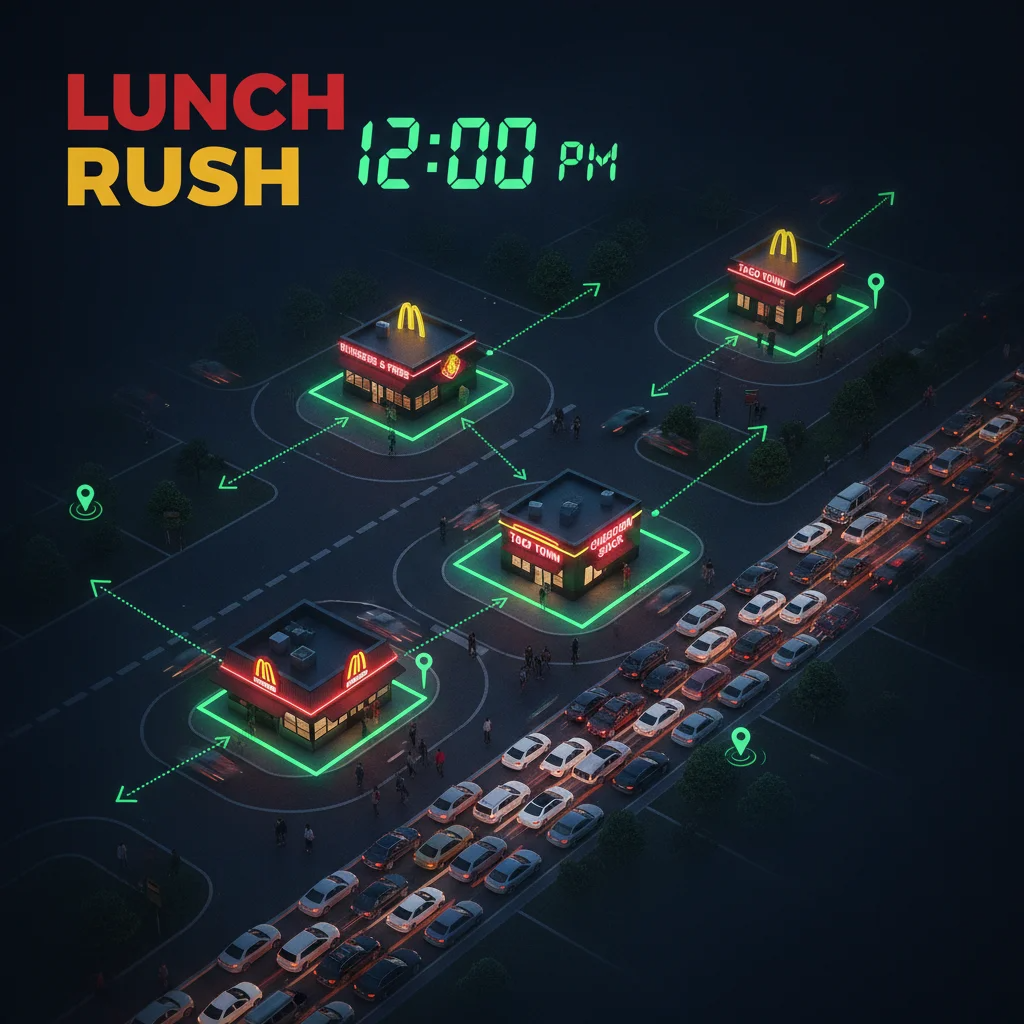
The polygon geofencing approach takes this a step further. Rather than drawing a simple circular radius around your restaurant, polygon geofencing allows you to create custom-shaped boundaries that precisely follow the outlines of buildings, parking lots, shopping centers, or city blocks. This means less wasted ad spend and more accurate audience targeting.
Why the Lunch Rush Is a Geofencing Goldmine
The lunch window is unique because consumer behavior becomes highly predictable. Office workers leave their buildings, students head to nearby food courts, and delivery drivers cluster around popular ordering zones. This predictability makes it easier to design effective polygon strategies that intercept customers at their most receptive moment.
- High purchase intent: People actively looking for food are far more likely to respond to relevant ads.
- Short decision cycles: Lunch breaks are time-constrained, making proximity and convenience critical.
- Repeat behavior patterns: Workers tend to follow the same lunch routines weekly, making them ideal for retargeting.
- Mobile-first audience: Lunchtime browsing spikes on mobile devices, where geofencing ads are most effective.
Strategy 1: Competitor Conquesting with Tight Radius Polygons
One of the most aggressive and effective geofencing strategies for QSR brands is competitor conquesting. This involves placing a geofence directly around a competitor’s location and serving targeted ads to anyone who visits that restaurant. The goal is to intercept their customers and lure them to your location instead.
Polygon geofencing is especially powerful here because you can draw the boundary to match the exact footprint of a competitor’s restaurant, parking lot, or drive-through lane — rather than casting a wide circle that might capture irrelevant passersby.
How to Execute Competitor Conquesting
- Identify top competitors: Focus on locations within a half-mile to one-mile radius of your restaurant.
- Draw precise polygons: Use satellite mapping tools to trace the building outline and parking lot of each competitor location.
- Time your ads strategically: Activate campaigns from 10:30 AM to 1:30 PM to catch customers before and during peak lunch hours.
- Craft compelling creative: Offer a clear value proposition — a discount, a faster service promise, or a menu item the competitor doesn’t have.
- Add a conversion zone: Place a polygon around your own restaurant to measure how many competitor-geofenced users actually visit you.
A well-executed competitor conquesting campaign can yield conversion rates 2-3x higher than standard display advertising because the audience has demonstrated active interest in your category. They’re already hungry and already buying fast food — you just need to give them a reason to choose you.
Creative Tips for Conquesting Ads
- Use urgency-driven language like “Skip the line — we’re just two blocks away.”
- Highlight unique menu differentiators that competitors can’t match.
- Offer a limited-time lunch deal to drive immediate action.
- Include a clickable map or “Get Directions” call-to-action button.
Strategy 2: Workplace and Office Park Polygon Targeting
The office worker demographic is a QSR brand’s best friend during the lunch rush. These individuals have predictable schedules, limited time, and a strong preference for convenience. Targeting office parks, corporate campuses, and business districts with custom polygon geofences is one of the highest-ROI strategies available to QSR media buyers. – Top Strategies for Programmatic Media Buyers to Maximize ROI and Drive Campaign Success in 2024
Unlike residential targeting, workplace geofencing captures users during peak hunger windows when they are physically near your restaurant and actively thinking about their next meal. The proximity combined with the time-of-day trigger creates an almost perfect storm of purchase intent.
Building Effective Workplace Polygons
The key to success here is granularity. Don’t just geofence an entire business district — break it down into individual buildings or office complexes. This allows you to prioritize high-density targets (large employers with hundreds of workers) over smaller offices that might not justify the ad spend.
- Use commercial real estate data to identify large office buildings near your location.
- Draw polygons that encompass building entrances and lobby areas where foot traffic is heaviest.
- Layer demographic data to prioritize buildings with white-collar workers who tend to have higher lunch budgets.
- Create a separate ad set for buildings within walking distance versus driving distance and tailor your creative accordingly.
Lunch Order Pre-Targeting
Consider launching your geofence campaign as early as 10:00 AM to 10:30 AM — before people have made their lunch decisions. Serving ads during this pre-decision window can plant the seed early enough to influence where someone chooses to eat 60 to 90 minutes later. Pair this with a mobile ordering call-to-action to drive pre-orders and reduce friction even further. (Learn more about geofencing)
Strategy 3: Commuter Corridor and Transit Hub Geofencing
Commuters represent a massive and often underutilized audience for QSR lunch targeting. Transit hubs, bus stops, subway stations, and park-and-ride lots all serve as natural congregation points where hungry people are in motion and open to food suggestions.
Polygon geofencing is particularly effective at transit locations because the boundaries can be drawn to match the precise layout of a station, platform area, or transit center — capturing dwell-time audiences without wasting impressions on people simply driving past.
Why Commuter Geofencing Works for Lunch
Many commuters follow predictable routes and timing patterns. Someone who takes the 8:15 AM train into the city every weekday is very likely to be near your geofenced transit hub again at lunchtime — especially if they work close to the station. By building audience profiles based on repeated visits to commuter zones, you can retarget habitual commuters with lunch ads timed to their typical midday movement patterns.
- Target park-and-ride lots near your restaurant location.
- Geofence bus shelters and transit stops along major corridors.
- Use lookalike modeling based on commuter audiences to expand reach.
- Serve ads featuring mobile ordering or drive-through options for time-pressed commuters.
Combining Commuter Data with Dayparting
Dayparting — the practice of scheduling ads to run only during specific time windows — pairs perfectly with commuter geofencing. Set your campaigns to run from 11:00 AM to 1:30 PM when commuters who work nearby are heading out for lunch. This ensures your budget isn’t wasted on morning or evening impressions that are less likely to convert.
Strategy 4: Event-Based and Contextual Polygon Layering
Special events create sudden spikes in local foot traffic that represent golden opportunities for QSR brands. Concerts, sporting events, festivals, farmers markets, and trade shows all draw large crowds who need to eat — and geofencing allows you to capitalize on these moments in real time.
Event-based polygon layering involves setting up temporary geofences around event venues, fairgrounds, convention centers, or outdoor spaces where gatherings are taking place. These campaigns are time-limited and highly targeted, making them incredibly cost-efficient when executed correctly.
Planning Your Event Geofencing Strategy
- Build an event calendar: Monitor local event listings, sports schedules, and community calendars at least two to four weeks in advance.
- Map venue polygons: Draw precise boundaries around the event space, including entrance areas, parking structures, and nearby pedestrian zones.
- Pre-load your campaigns: Have your ad creative and geofence polygons ready to activate quickly as events approach.
- Contextual creative matching: Tailor your ad messaging to the event type — a post-game meal deal for a sports event, or a quick lunch offer during a trade show break.
- Extend the retargeting window: After the event ends, retarget attendees for 7 to 14 days with follow-up offers to maintain brand recall.
Stacking Polygons for Maximum Coverage
Consider layering multiple polygons around a single event — one tight polygon around the venue itself, another around the surrounding blocks, and a third around nearby parking garages. This tiered approach ensures you capture attendees at multiple touchpoints throughout their event experience, significantly increasing the frequency of your brand message. – How can data insights boost your CTV ads and engage your audience in 2025?
Strategy 5: Lapsed Customer Re-Engagement Through Visit Retargeting
Not all geofencing strategies are about acquiring new customers. Some of the most cost-effective campaigns focus on re-engaging lapsed customers — people who have visited your restaurant in the past but haven’t returned recently. Visit retargeting uses historical location data to identify these individuals and serve them personalized ads designed to win them back.
This strategy is uniquely powerful for QSR brands because fast food customers are creatures of habit. If someone visited your location multiple times and then stopped, there’s usually a reason — a bad experience, a new competitor, or simply forgetting you exist. The right ad at the right moment can reignite that relationship.
Setting Up a Visit Retargeting Campaign
- Define your lapse window: Identify customers who haven’t visited in 30, 60, or 90 days depending on your normal visit frequency.
- Segment by visit history: Create separate audience segments for high-frequency visitors (weekly) versus occasional customers (monthly) to personalize your messaging.
- Offer a compelling win-back incentive: A free side item, a BOGO deal, or a loyalty points bonus can be enough to trigger a return visit.
- Activate during the lunch window: Schedule your retargeting ads to serve between 10:30 AM and 1:00 PM when the customer is most likely to act on a food-related message.
- Track conversion zones: Place a geofence around your restaurant to measure how many retargeted users actually return after seeing your ad.
Combining Visit Retargeting with Loyalty Data
If your QSR brand has a loyalty app or rewards program, you can enrich your geofencing data with loyalty purchase history for even more precise targeting. Customers who previously ordered a specific menu item can be retargeted with ads featuring that exact item or a newer version of it. This level of personalization dramatically improves ad relevance and click-through rates. (Learn more about geofencing)
Best Practices for QSR Geofencing Campaigns
Running successful geofencing campaigns for the lunch rush requires more than just drawing polygons and hitting publish. Here are the most important best practices to keep in mind as you build and optimize your campaigns.
Polygon Size and Accuracy
- Keep polygons tight and precise: Overly large geofences capture too many irrelevant users and inflate your ad spend. Aim for boundaries that match the actual physical space you want to target.
- Use satellite or aerial map views when drawing polygons to ensure accuracy.
- For competitor conquesting, draw separate polygons for the building and the drive-through lane, as these represent different audience behaviors.
- Avoid overlapping polygons for different campaign objectives, as this can cause audience confusion and budget cannibalization.
Ad Creative for the Lunch Audience
The creative execution is just as important as the targeting strategy. Lunch rush ads need to be fast, clear, and action-oriented. Here’s what works best:
- Use mouth-watering food imagery that’s relevant to your current menu or promotion.
- Keep copy concise — no more than one to two sentences highlighting your value offer.
- Always include a strong CTA such as “Order Now,” “Get Directions,” or “Claim Your Deal.”
- Incorporate a countdown or limited-time element to create urgency.
- Optimize for mobile display since the vast majority of geofencing impressions are served on smartphones.
Frequency Capping
One of the most overlooked elements of geofencing campaign management is frequency capping. Serving the same ad to the same person five or six times per day will quickly lead to ad fatigue and negative brand sentiment. Cap your daily impressions at three to five per user and spread them across the pre-lunch and lunch windows for maximum effectiveness.
Testing and Iteration
Always run A/B tests on your polygon shapes, ad creative, and offer types. A slightly different polygon that includes a nearby parking lot might capture a meaningfully different audience than one that doesn’t. Small changes can have significant impacts on campaign performance, so build a culture of continuous testing into your QSR geofencing program.
Measuring the Success of Your Geofencing Lunch Rush Campaign
Tracking the right metrics is essential for proving the ROI of your geofencing investment and optimizing future campaigns. Unlike traditional digital advertising metrics, geofencing success is measured with a combination of digital performance data and real-world foot traffic attribution.
Key Metrics to Track
- Walk-in rate (lift): The percentage of users who saw your geofencing ad and subsequently visited your location. This is the most direct measure of campaign effectiveness.
- Cost per visit (CPV): Total campaign spend divided by the number of verified store visits. Compare this against your average transaction value to evaluate ROI.
- Click-through rate (CTR): Measures engagement with your ad creative. A low CTR may indicate that your offer or creative needs refinement.
- Conversion zone attribution: Measures how many users who entered a competitor’s geofence (or another targeting polygon) ultimately visited your restaurant.
- Frequency and reach: Monitor how many unique users are being reached and how often to avoid ad fatigue.
- Daypart performance breakdown: Analyze which time windows within the lunch rush generate the highest conversion rates to refine your dayparting strategy.
Using Foot Traffic Analytics Platforms
Several leading platforms specialize in foot traffic attribution for geofencing campaigns, including Placer.ai, GroundTruth, and Foursquare. These tools can provide detailed visit attribution reports, audience demographic breakdowns, and competitive benchmarking data. Integrating one of these platforms into your measurement stack will give you a much clearer picture of how your lunch rush campaigns are performing in the real world.
Benchmarking Against Industry Standards
For QSR geofencing campaigns targeting the lunch rush, here are some general performance benchmarks to guide your expectations:
- Walk-in conversion rate: 8%–15% is considered strong for competitor conquesting campaigns.
- CTR: 0.25%–0.75% is typical for location-based mobile display ads.
- Cost per visit: Ranges from $2 to $8 depending on market density and campaign complexity.
- Lift over control: A successful geofencing campaign should show a 20%–40% lift in store visits compared to a non-targeted control group.
Conclusion
The lunch rush is the most competitive battleground in the QSR industry, and geofencing polygon strategies offer a powerful way to win it. Whether you’re conquesting competitors, targeting busy office workers, intercepting commuters, capitalizing on local events, or re-engaging lapsed customers, each of the five strategies outlined in this guide provides a proven path to higher foot traffic and stronger midday revenue.
The key to success lies in precision. Custom polygon geofences that match the exact layout of real-world locations outperform simple radius targeting every time. Combine that precision with compelling ad creative, smart dayparting, and rigorous performance measurement, and you’ll have a lunch rush geofencing program that delivers measurable results week after week.
As mobile location data continues to improve in accuracy and coverage, the opportunity for QSR brands to leverage geofencing will only grow. Now is the time to build your polygon strategy, test your targeting approaches, and position your brand as the go-to choice for every hungry customer who steps within range of your virtual boundaries. Start drawing your polygons — your next loyal customer is already nearby.